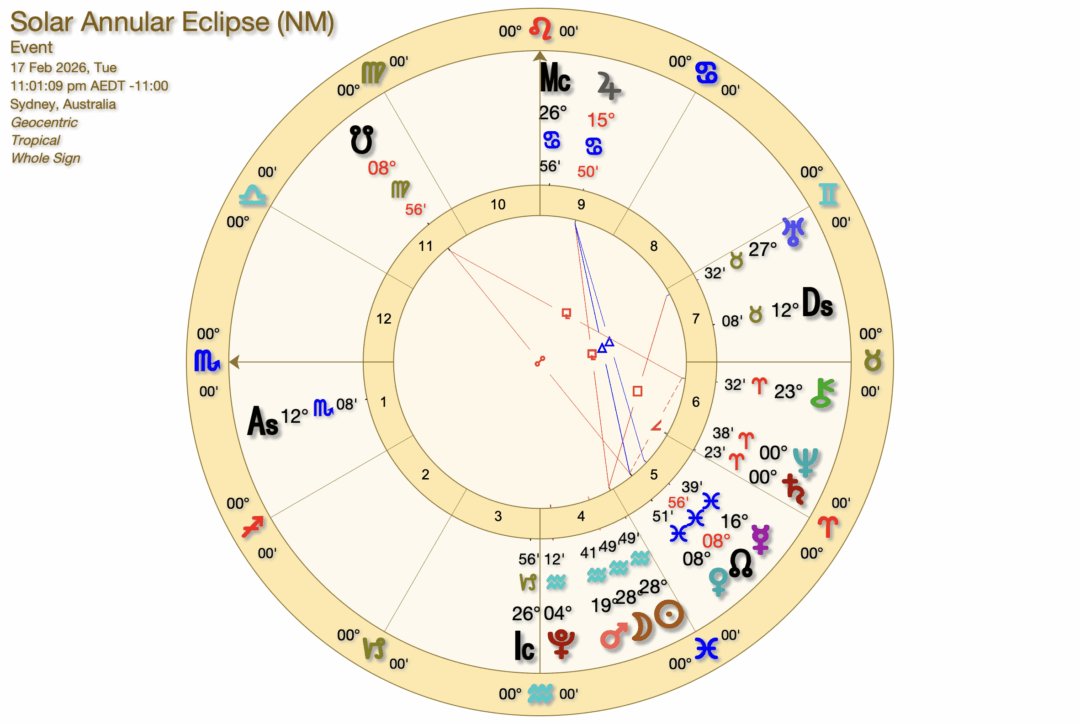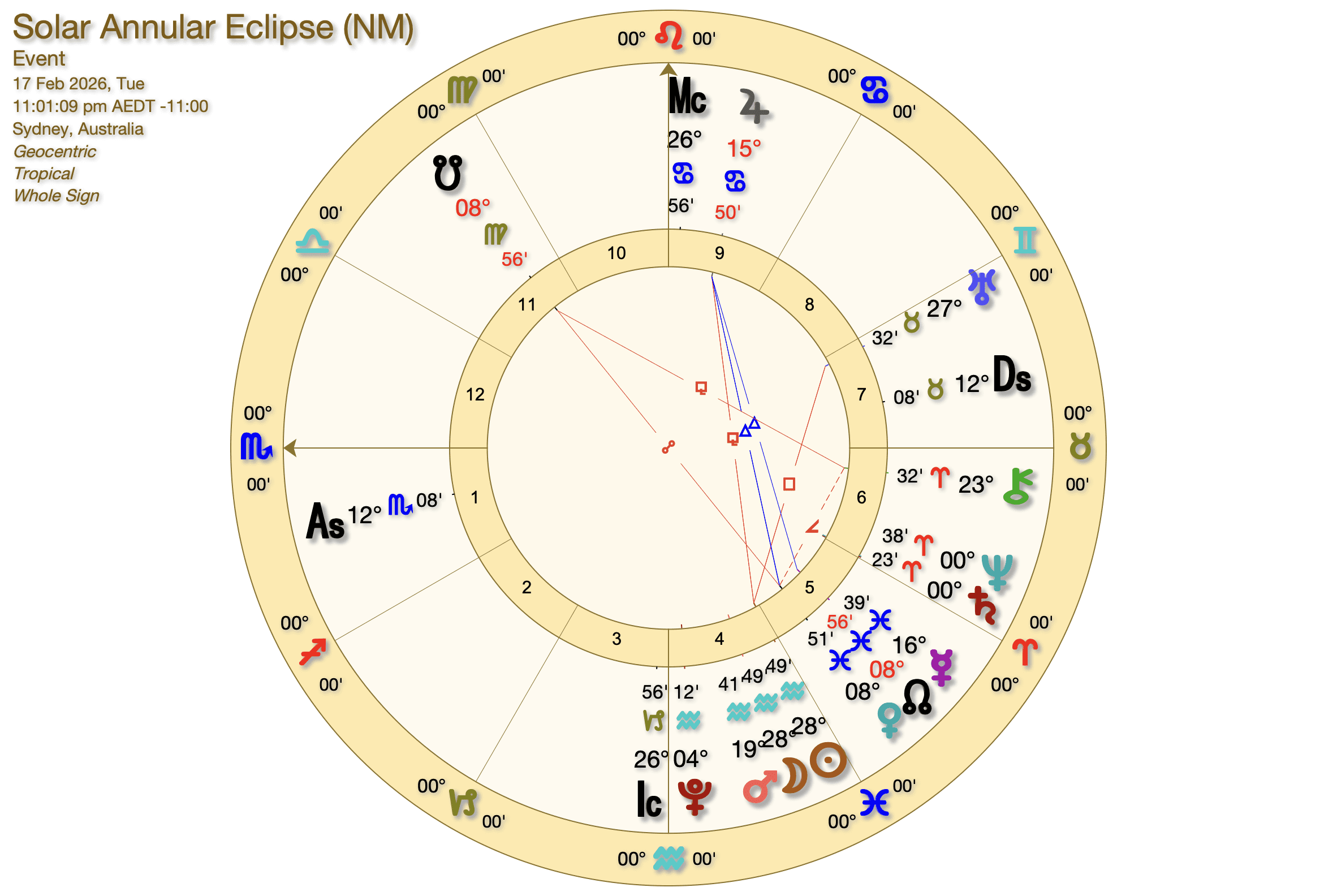
The first Solar Eclipse (New Moon) of the year occurs on Tuesday 17 February 2026, with the Sun and Moon coming together at 28°49′ in the sign of Aquarius (the Water Bearer), which is exact at 11:01PM Australian Eastern Daylight Time (AEDT). This is the first in a series of three Solar Eclipses occurring in the sign of Aquarius, with the next one in 2027, and the final one in 2028. Plus. this new eclipse cycle starts off the Aquarius-Leo axis that we haven’t experienced since 31 January 2018.
You may need to convert the date and time details into your time zone, which can be done here.
Solar eclipses are intensified new moons where the Sun and the Moon come together, highlighting new beginnings. A new start where we leave behind the old and outworn that no longer serves us to make space for something more real and true for us.
The sign of Aquarius – Fixed Air
Aquarius is one of the signs (along with Gemini and Libra) which is associated with the Air element of the intellect, learning, abstract reasoning, communication, idealism, and, being objective, rational, logical and broadminded. Some keywords for Aquarius include: independence, inventiveness, humanitarianism, being unconventional, friendly, altruistic, idealistic, progressive and possibly cool and impersonal, detached, distant, unemotional and even eccentric.
Aquarius also has a Fixed quality or mode (along with Taurus, Leo and Scorpio). The Fixed modality signifies the middle of the seasons. Fixed energy is steadfast; these signs are routine, regular and have a sense of pattern. Since Aquarius is an Air sign, the fixity manifests on the mental realm, standing firm and even being rigid on ideas and perspectives.
People born with the Sun in the sign of Aquarius (around 19 January until 18 February each year) may also be quite society-oriented, preferring group egalitarianism over hierarchical relationships. The Sun in its sign of Detriment or Exile in Aquarius as the Sun is concerned with individual expression, not group equality.
Saturn and Uranus ruling the sign of Aquarius
Aquarius is ruled by the planets Uranus (modern ruler) and Saturn (traditional ruler). Saturn’s relationship with Aquarius is connected with our social groups; taking sides, asking who is an insider and who is on the outside, and marginalised. Saturn rules boundaries, rules, commitment and stability. Uranus’ connection with society includes rebellion, freedom, originality, genius, science, electricity, astrology, technology, being futuristic, and bohemian.
Eclipse aspects
This eclipse is very closely squaring a newly direct Uranus in Taurus at 27°32′, which is now building momentum and ‘shaking things up’ before it enters Gemini in April 2026, ushering in a new chapter in our lives. We may be feeling the urge to break free, or there may be a ‘breaking down’ and ‘breaking through’ time before we enter the new 7 year cycle of Uranus in Gemini. Our lives can be disrupted and feel chaotic, however this is necessary for us to move towards a more real or authentic version of ourselves. When Uranus comes along and we feel restless and it’s unsettling; it’s time for change.
We may also experience breakthroughs in our collective actions and in group organisation and collaboration, especially if we/they are encouraging equality.
We also have Pluto (power / control / death and rebirth / regeneration) and Mars (assertion / severing / separating) transiting the sign of Aquarius at the time of the eclipse. Pluto has now finished dredging up the wrongdoing of those at the top in the hierarchical sign of Capricorn, and is now in the process of levelling the power dynamic for the collective as equal players in society. Further, there is volatility connected with this eclipse; Mars will soon transit the eclipse degree (28 February), after squaring Uranus on 27 February, and Saturn will exactly conjunct Neptune on 20 February in Aries, one of the signs Mars rules.
This Aquarius Solar Eclipse heralds themes of community and social (r)evolution; a time of individual and collective upheaval.